



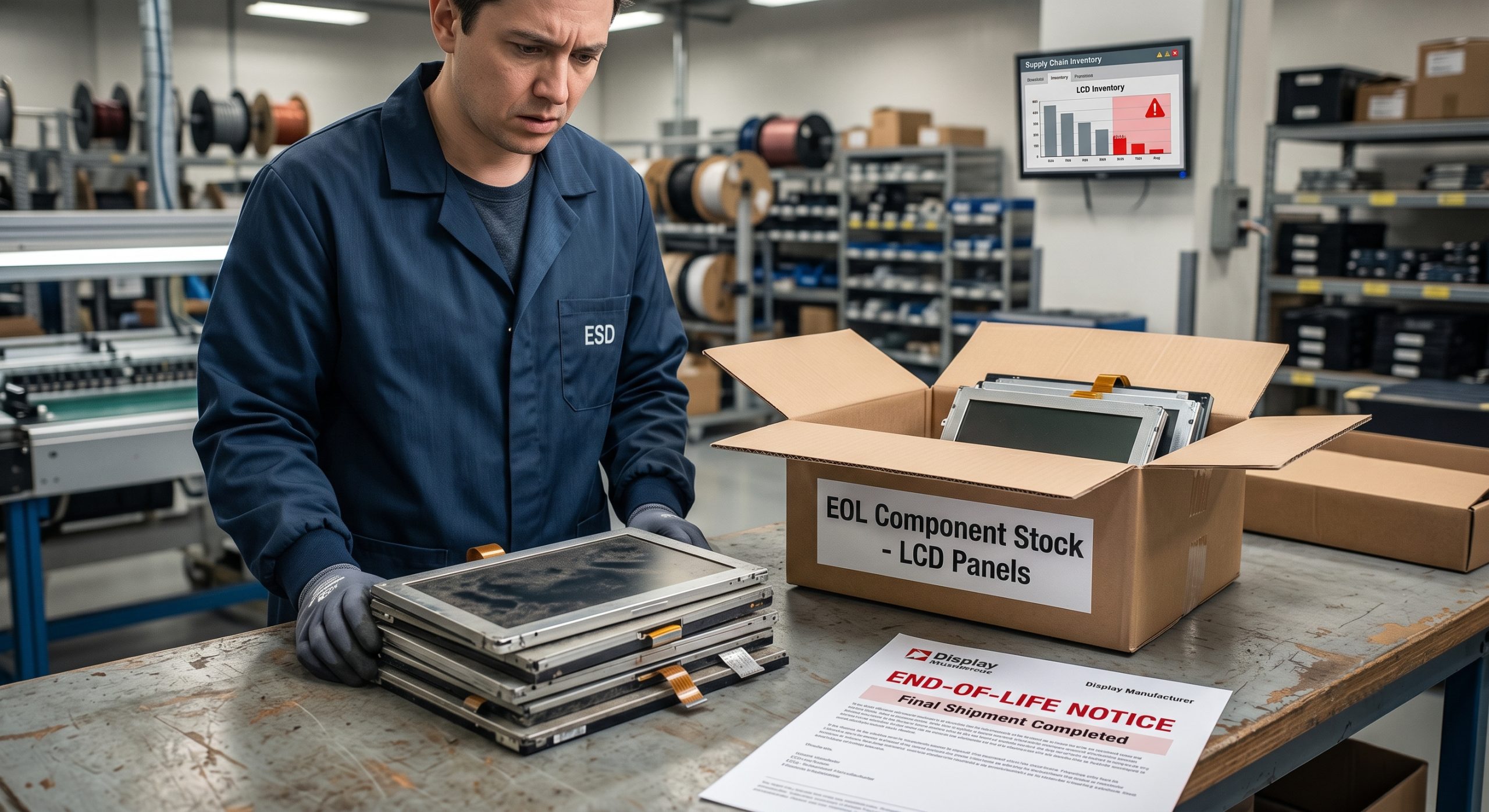
If you are managing long-lifecycle products in industrial, medical, automotive, or aerospace sectors, you are likely familiar with the dreaded End-of-Life (EOL) notice. But there is a specific phase of this cycle that is catching many OEMs off guard, quiet until it’s suddenly a crisis: LCD EOL Exhaustion.
It’s one thing when a display manufacturer announces they are discontinuing a panel. It’s an entirely different battle when the residual market stock of that display completely dries up—leaving your production line stranded.
Here is a look at why LCD EOL exhaustion is accelerating, and how forward-thinking engineering and procurement teams can protect their lines.
Why LCD Lifecycles are Shrinking
Consumer tech moves fast, but industrial tech is built to last. This fundamental mismatch is the root cause of EOL exhaustion.
Display manufacturers (fabs) optimize their production lines for high-volume industries like smartphones, TVs, and automotive dashboards. When a consumer trend shifts—say, from traditional LCD to OLED or micro-LED—fabs retool their lines.
For an industrial OEM using a niche 7-inch LCD panel, this triggers a sudden EOL notice. You are given a window for a Last Time Buy (LTB). But what happens if your demand forecasts change, or the broker market runs out of stock faster than anticipated? You hit the exhaustion wall.
[EOL Notice Issued] ➔ [Last Time Buy Window] ➔ [Market Stock Depletion] ➔ ⚠️ EXHAUSTION WALL
The Hidden Price of Late-Stage Adaptation
Many product teams treat display obsolescence as a simple sourcing problem, but the true cost of an EOL event stretches far beyond buying a replacement panel. Depending on the complexity of your device, adapting to a new LCD architecture can easily spiral into a major financial and operational burden.
Below is an estimated breakdown of the hidden engineering, compliance, and supply chain costs associated with adapting to an LCD EOL event late in a product’s lifecycle:
| Phase / Cost Component | Estimated Cost Range (USD) | Primary Drivers & Impact |
|---|---|---|
| Mechanical Redesign | $5,000 – $25,000 | Bezel modifications, enclosure tooling changes, bracket adjustments. |
| Electrical & Driver Rewriting | $10,000 – $40,000 | Timing controller adjustments, firmware updates, pinout adaptations. |
| Regulatory Recertification | $15,000 – $80,000+ | Medical (FDA), industrial, or aviation compliance testing if internal layouts shift. |
| Opportunity Cost (Downtime) | $20,000 – $150,000+ | Delayed shipments, idle assembly lines, and lost market share during validation. |
| Total Estimated Impact | $50,000 – $295,000+ | Varies heavily based on strictness of regulatory environments. |
The Compounding Costs of Component Exhaustion
When an LCD panel hits total market exhaustion, the ripple effects go far beyond purchasing a more expensive replacement.
- The Redesign Trap: A new LCD rarely drops perfectly into an old enclosure. Differences in bezel size, ribbon cable placement, or backlight voltage can trigger a cascading redesign of your mechanical housing and internal PCBs.
- Software Real Estate: Changing a display often means changing the display driver. This requires software engineers to rewrite firmware and re-test UI elements.
- Recertification Roadblocks: In regulated fields like medical devices (FDA) or aerospace (FAA), a modified display can alter the system’s emissions or safety profile, forcing you back through a costly and lengthy recertification process.
The Evolution of the Form Factor: Shifting Ratios and Resolutions
The risk isn’t just that a panel will stop being manufactured; it’s that the entire standard of what is “normal” in display geometry is evolving.
Historically, industrial automation and legacy equipment relied heavily on “square” formats—namely 4:3 or 5:4 aspect ratios with standard VGA or SVGA resolutions. However, modern fabrication facilities have shifted their machinery entirely to cater to modern consumer aesthetics. Today, we are seeing LCDs shifting aspect ratios and resolutions away from these traditional square footprints toward long, narrow displays (like 16:9, 21:9, or custom stretched “bar” formats).
When a legacy square display goes EOL, finding an identical structural drop-in replacement becomes nearly impossible. Engineers are suddenly forced to choose between redesigning the product’s outer chassis to fit a narrower display or investing heavily in custom display glass tooling.
Proactive Strategies to Beat the Exhaustion Curve
Waiting for an EOL notice to land in your inbox is a reactive strategy that costs time and money. To build a resilient supply chain, consider these three pillars:
- Design for Component Agility
When developing a new product, challenge your engineering team to design with the next display in mind. Utilize open-standard interfaces (like LVDS or MIPI DSI) rather than proprietary ones. If possible, design internal brackets or carrier boards that can adapt to slight variations in display dimensions without requiring an overhaul of the main chassis.
- Lock in Lifecycle Agreements Early
When sourcing a display, look beyond the price sheet. Evaluate the manufacturer’s track record for longevity. Establish contractual agreements regarding EOL notification windows (e.g., a minimum 12-to-18-month notice) and guaranteed support periods.
- Partner with Legacy & Transition Specialists
You don’t have to predict the market alone. Partnering with supply chain specialists who actively monitor component lifecycles allows you to see the storm coming. Whether it’s securing bonded inventory during a Last Time Buy window or sourcing drop-in replacements that mimic the form, fit, and function of the exhausting panel, early collaboration is key.
The Bottom Line
The silent supply chain disrupter doesn’t have to be fatal to your product line. By understanding the economic forces that drive fab retooling, accounting for the evolution of modern aspect ratios, and planning for the true cost of hardware adaptations early, engineering and procurement teams can ensure their products remain active, compliant, and profitable for years to come.


